
Residential
Rinsing your AC helps. It can also hurt.
A Garden City homeowner rinsed the outdoor unit every summer. The cottonwood was still packed in the fins, and sitting on the weep holes the unit drains through.
Diagnostics
·
Maintenance
Garden City, ID
5 min
read
A Garden City homeowner had been rinsing the outdoor unit every summer. It's the one piece of an air conditioner a homeowner can actually get to, and rinsing it is the sensible thing to do. The cottonwood was still in there.
A Garden City homeowner had been rinsing the outdoor unit every summer. It's the one piece of an air conditioner a homeowner can actually get to, and rinsing it is the sensible thing to do.
The cottonwood was still in there.
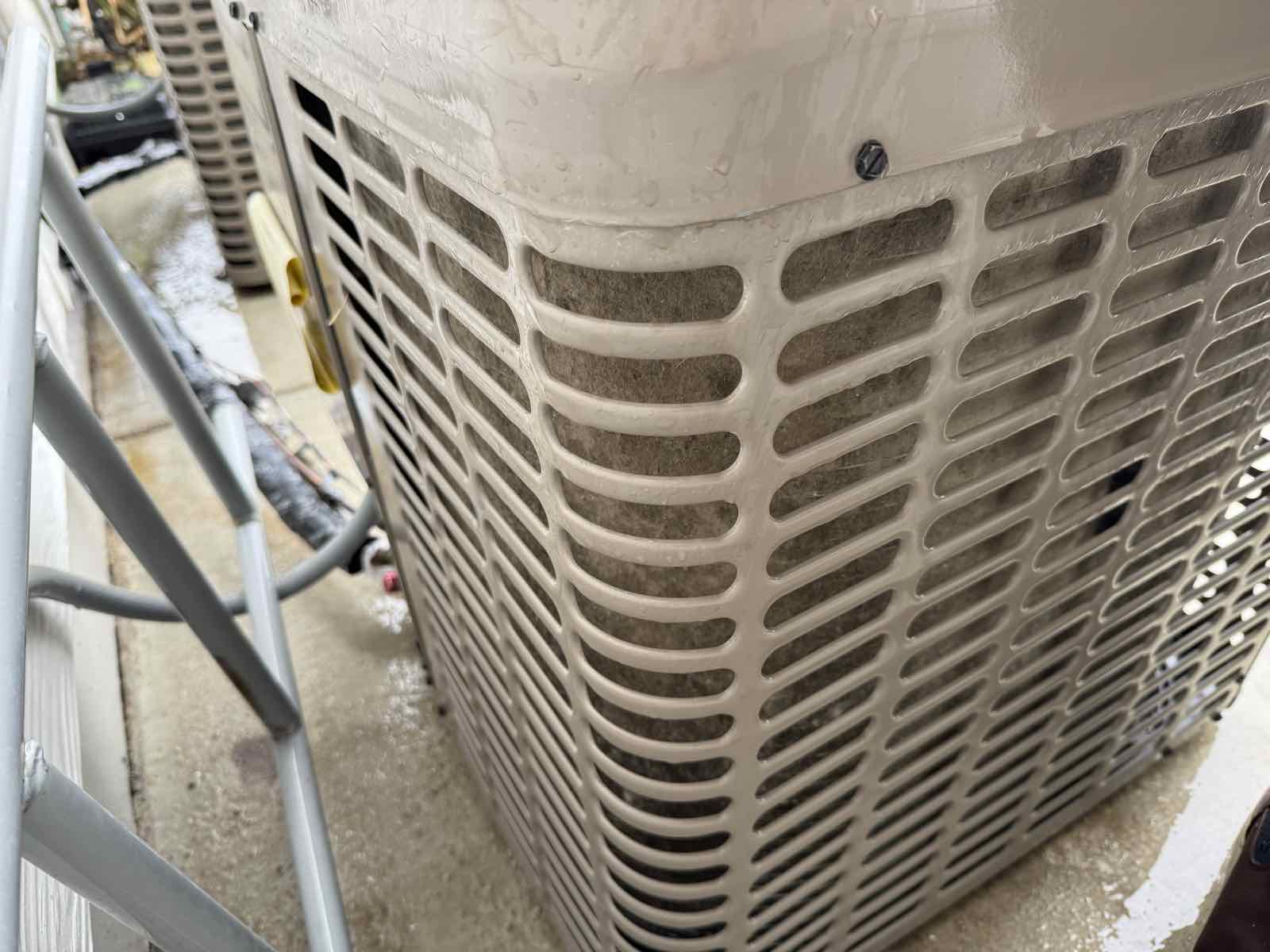
Cottonwood packed into the fins of the outdoor coil, seen from outside the unit.
The thing you've been doing helps. It just doesn't reach.
Cottonwood doesn't sit on the outside of a condenser. It packs into the fins, the tight aluminum layers that make up the coil, and it goes in deep enough that a garden hose can't follow it.
Angle matters. Pressure matters. So does whether the outer panel comes off first, which most homeowners don't do, and shouldn't have to. Sprayed from the wrong angle, water pushes the debris further into the coil instead of out of it. The unit looks cleaner. The fins are more packed than they were.
That's the part nobody mentions. The effort is real, it's worth making, and it has a ceiling.
What you can do, and where it stops
Worth doing: Keep the area around the outdoor unit clear. Two feet on all sides, no bags of mulch, no stacked patio furniture, nothing growing against it.
Worth doing: Rinse the outside of the unit gently, straight down from above, not sideways into the fins. It won't reach the packed debris, but it will move what's loose before it works its way in.
Worth doing: Look at the fins from a few feet back. If you can see a grey or brown mat filling the gaps, the coil is loaded and rinsing won't clear it.
Where it stops: The debris that's actually choking the machine is between the fins, and it only comes out from the inside. That means the fan assembly has to come off. Don't attempt this — the fan is heavy, it's wired, and putting it back out of alignment creates a new problem.
When to call: If the unit runs longer than it used to, sounds louder than it used to, or the house never quite gets cold on a hot day, something is blocking the airflow. That's worth an evaluation.
The debris never stopped at the coil
We pulled the fan assembly out of both of this home's condensers, which is the only way to see the bottom of the cabinet.

The base of the cabinet with the fan assembly removed. Debris sitting on the weep holes the unit should drain through.
The debris was everywhere. Packed into the coil from the inside, yes. But also lying across the cabinet floor, sitting on the fan motor, settled into the wiring and the compressor connections. A season of cottonwood and sand doesn't stop politely at the surface a homeowner can see.
And it was sitting directly on the weep holes.
The part that ends a machine early
The weep holes are small openings in the base of the cabinet. They're how water leaves the unit. Rain, condensate, the runoff from every rinse. Water gets in constantly and it's supposed to go straight back out.
Blocked with wet debris, it doesn't.
This is the failure that matters most, and it's the one nobody talks about, because it's slow and it's out of sight. Once the weep holes clog, they tend to stay clogged. The debris compacts, the water stands, and the water doesn't leave between seasons. It sits against the frame, the compressor mount, and the coil mount, for years.
That's structural corrosion, not a worn part. It isn't repaired. Those mounts often aren't worth replacing, and on an older machine they may not be available at all. A system with a perfectly healthy compressor can reach the end of its life because the floor it's bolted to rusted out underneath it.
What the packed coil was quietly doing
The condenser coil is how an air conditioner releases the heat it pulled out of your house. It's the one surface in the whole system that has to stay clear.
Packed with cottonwood, it can't. The heat has nowhere to go. So the system runs longer to reach the same temperature, the compressor works harder every hour it's on, and the house feels almost right instead of right.
The machine keeps running. It just wears out early.
You paid for a fifteen-year machine. Nothing announces that you're getting ten.
★★★★★
"Now our unit runs efficiently and our house feels perfectly temperature controlled."
— A Garden City homeowner, after a Condenser Restoration
Both systems, running the way they were built to
We opened both condensers and cleared the coils from the inside out, the direction the debris came in. We cleaned the cabinet floors and opened the weep holes so water could actually leave the units. We measured the fan bearings, the blade pitch, the electrical and compressor connections, and the housing, and corrected what was out of spec.
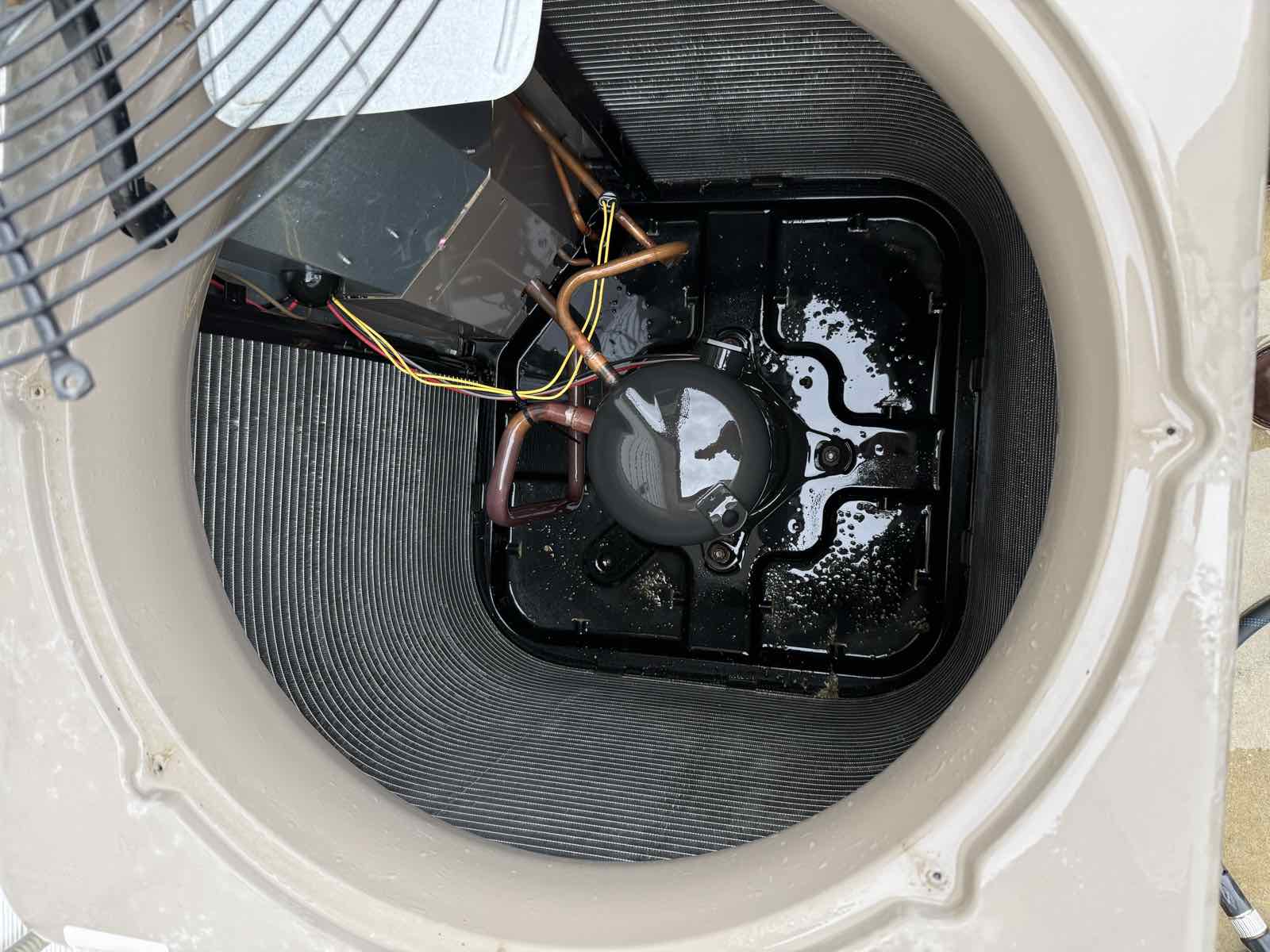
The same cabinet, cleared.
Then we rinsed all of it well away from the pad, so it couldn't dry in place and get pulled straight back in on the next cycle.
We call this a Condenser Restoration. It isn't a rinse and it isn't a step inside a maintenance visit. It's what an outdoor unit needs when a season of debris has packed the coil.
What it sounds like at your house
You won't get an alarm for this. What you'll notice, if you're paying attention, is smaller:
A system that runs longer to reach the same temperature than it used to.
An outdoor unit that's gotten louder.
A house that never quite gets there on a hot afternoon.
None of those look like a failure. That's exactly the problem.
The machine keeps running. It just wears out early.
A Garden City condenser, packed with a season of cottonwood
The result
Both systems moving air the way they were built to
We cleared both coils from the inside out, cleaned the cabinet floors, and opened the weep holes so water could leave the units. We measured the fan bearings, the blade pitch, the electrical and compressor connections, and the housing, and corrected what was out of spec. Then we rinsed the debris well away from the pad, so it couldn't dry in place and get pulled straight back in.

Built for predictable performance
If your HVAC sounds or feels different than it used to
Northstead provides residential and commercial HVAC evaluation, repair, and predictive maintenance throughout Boise, Eagle, Meridian, and the greater Treasure Valley.
Bi-annual maintenance is recommended to identify component wear before it becomes a system failure.