
Residential
Replacing a 33-year-old system is the chance to rethink how the house is conditioned. This one moved to a heat pump, with a gas furnace for the coldest days.
After 33 years the old system came out and a heat pump went in, on the same ductwork and at the same capacity. Replacement was the chance to get more from the house.
Diagnostics
·
Furnace
·
Replacement
Boise, ID
4 min
read
The system was 33 years old and still cooling. Its replacement heats with a heat pump most of the year and switches to gas when it's cold.
If the system in your house has run for decades and still cools it, nobody needs to tell you it's old. You want to know whether the next repair is worth making, or whether it's going into equipment at the end of its service life.
A Boise homeowner called us about water in his basement. A restoration crew was already drying it out when we arrived, the water heater had been the first suspect, and the source turned out to be the indoor air conditioning equipment. He asked on that first visit what a new system would cost. We found the leak and stopped it first.
The water was a drain problem
The primary condensate drain was restricted with debris. The assembly had been built up over the years from pipe size reductions, threaded adapters, and a run of vinyl tubing down to a condensate pump that had failed and was leaking on its own, and each of those transitions is a spot where debris catches. With the drain restricted, condensate backed up into the evaporator cabinet instead of leaving the house. We cleared the tubing, flushed and tested the drain until it ran freely, cleaned the evaporator coil as far as we could without invasive disassembly given the equipment's condition, cleared the compartment and drain pan, and cleaned the condenser coil outside. The system was cooling when we left, and the water stopped.
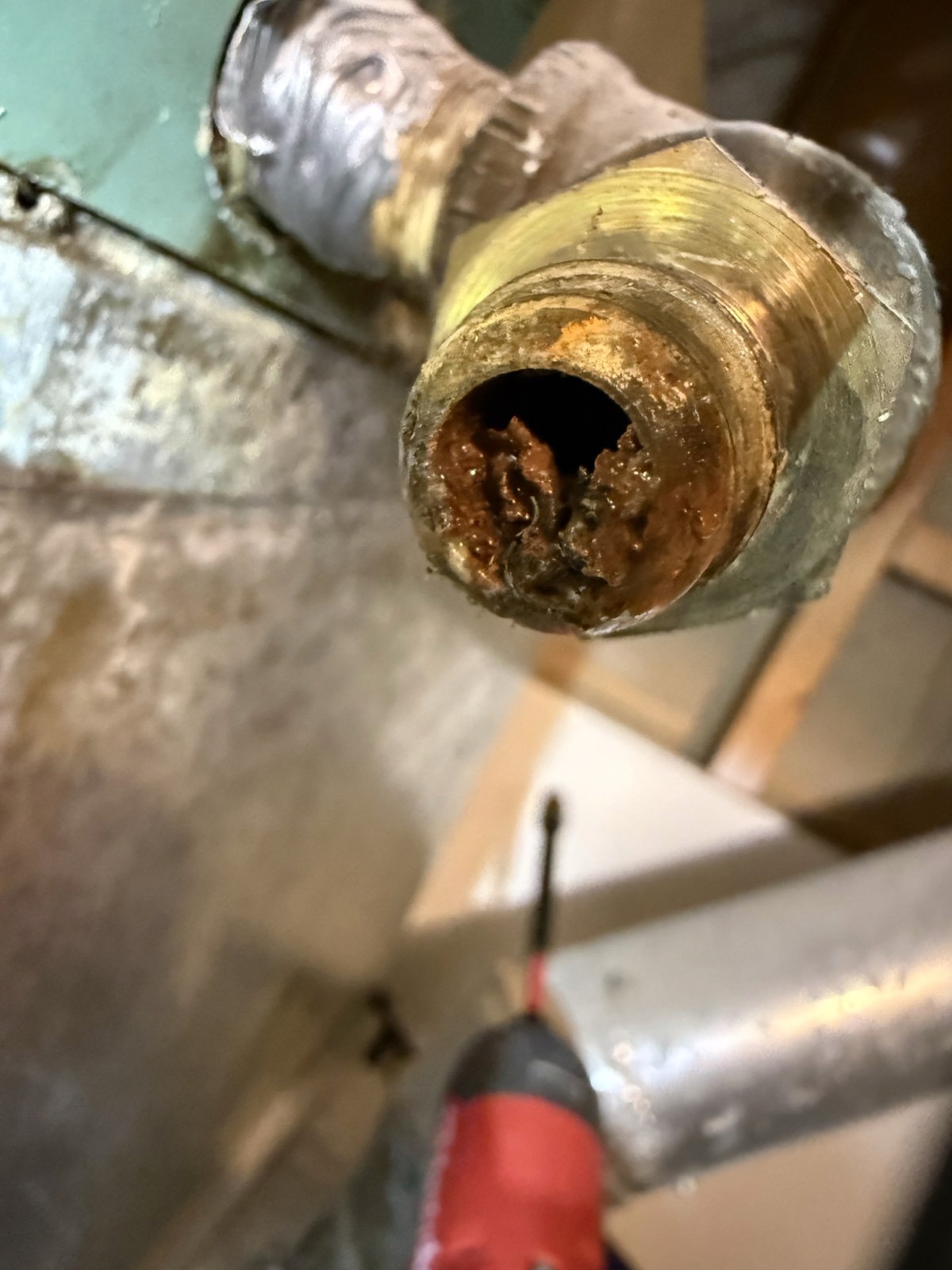
The drain fitting that put water on the floor, packed with debris where the assembly necked down.
What another repair would have been buying
The furnace and the outdoor unit were about 33 years old. The evaporator coil and drain pan carried rust staining and biological buildup consistent with that age, the sensing bulb on the metering valve had lost its insulation, and the electronic air cleaner was obsolete. Inside the blower compartment, an old filter had been pulled into the blower wheel and was wrapped around it, loading the motor. None of it was an emergency, and each item is repairable on its own. The question was what each repair would be spent against. The refrigerant charge was off, and while it could have been topped off, R-22 is no longer produced, which makes even that repair costly. On equipment that far past its expected service life, the drain assembly alone was never going to be reliable in that configuration, no matter how many times it got cleared.
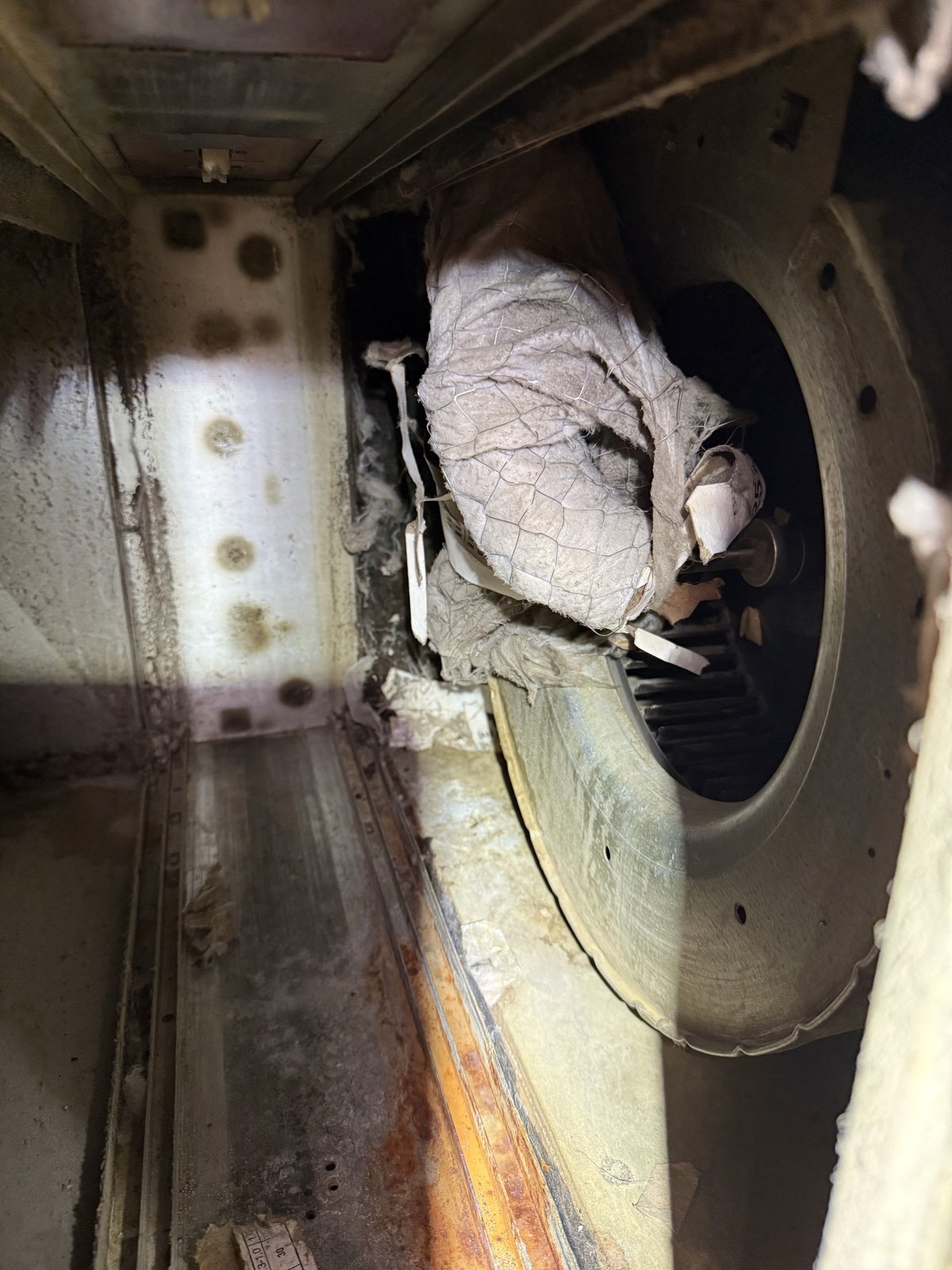
An old filter, pulled into the blower wheel and wrapped around it. One of the finds inside the 33-year-old cabinet.
We laid out the options for repair and for replacement, with what each would and wouldn't accomplish. The decision was his, and the system was running, so there was time to make it.
Why the new system is the same size as the old one
Eleven days later, the homeowner replaced it with a 2-ton dual-fuel system, the same capacity that came out.
When replacement is the call, our part is fitting the new system to the house: what the ductwork can carry, what the home has proven it needs, and where a heat pump earns its place. Total external static pressure on the existing ductwork showed the duct moving air well for the equipment attached to it, which meant it could carry a new system without being rebuilt. And the home itself had three decades of record that 2 tons heated and cooled it. Nothing about the house had changed.
A full engineering analysis is the right call when the duct measures poorly or the house has been added onto. Neither was true here, so the engineering and duct evaluation we offer stayed what it is, a separate design service for homeowners who want the home optimized beyond a standard replacement.
Heat pump first, gas when it gets cold
Dual fuel means two sources of heat under one control, and it fits how Boise winters actually run. A heat pump moves heat instead of making it, so it heats and cools the house on less energy for most of the year, with the outdoor inverter unit carrying the heating and all of the cooling. On the coldest days, when gas becomes the better source, the gas furnace takes over automatically and the house heats the way it always has. The furnace uses the venting already in place, so the switch to a heat pump didn't require rebuilding the flue.
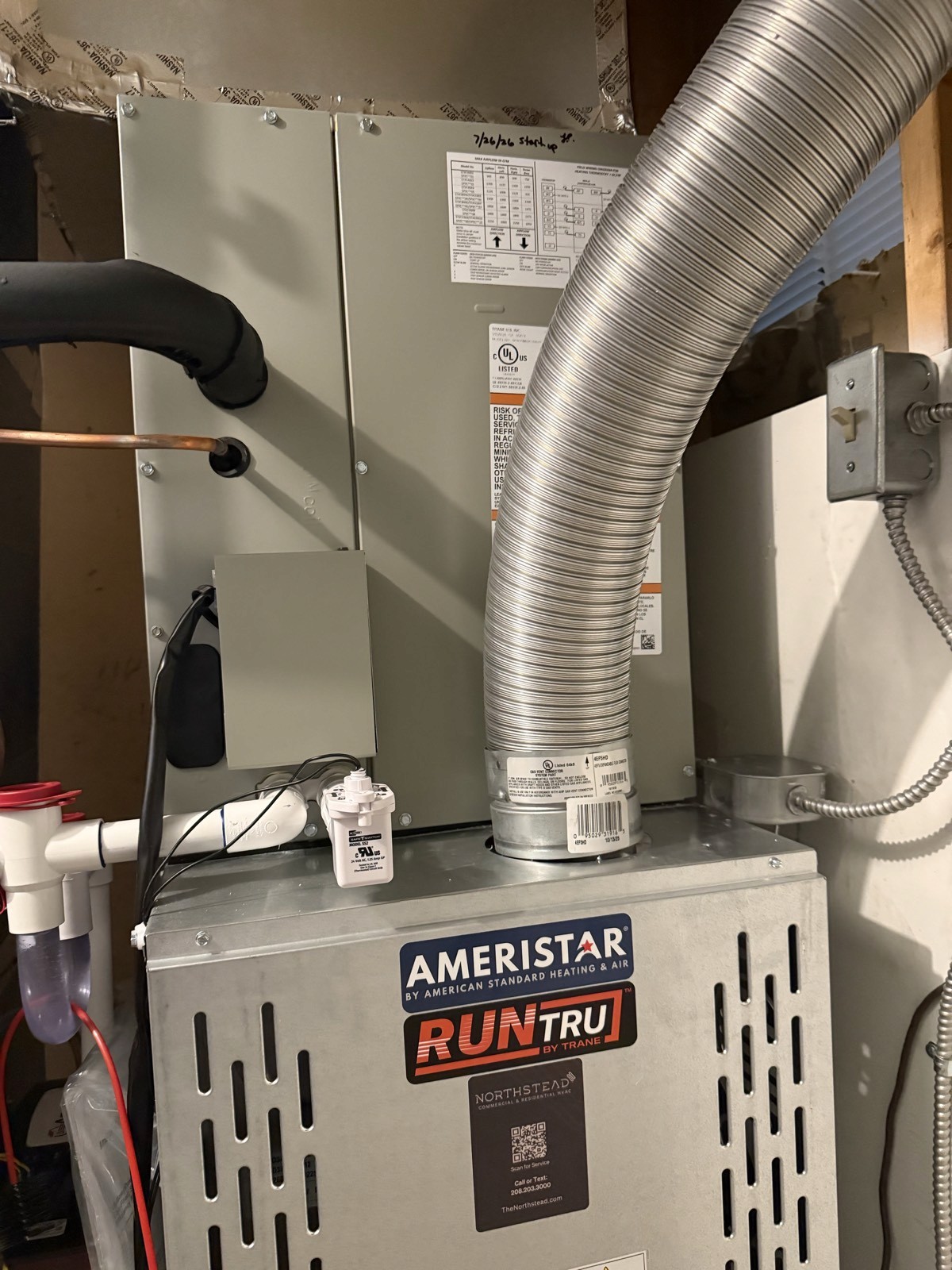
The new furnace, venting through the flue path already in place. The float switch shuts the system down if the drain ever backs up.
The refrigerant is current-generation, so the new system starts its service life on a refrigerant that will be made and stocked for years, the opposite of the corner the old system was in.
We verified the changeover between heat pump and furnace before we finished.
The install
The existing ductwork stayed, and that is most of what kept this a replacement rather than a rebuild. Everything else is new: the heat pump, the indoor coil and furnace, refrigerant piping, a media filter cabinet, a condensate pump and drainage with float switches that shut the system down if it ever backs up again, a gas valve and connections with verified pressure, a new electrical service switch with surge protection and grounding, and a dual-fuel thermostat on rewired controls, since the old thermostat wiring had shorted. The work was permitted and inspected, and we did it while he was out of town, so he came home to a running system. Then we commissioned it: ran the manufacturer's startup procedure, confirmed heating and cooling, checked refrigerant performance and operating pressures, tested airflow on the new equipment, verified temperature split and furnace temperature rise, and walked him through the system when he was back.
We can help
If your furnace and AC are old enough that you're weighing the next repair, a replacement is the chance to rethink how the house is conditioned. We give you solid options for repair or replacement, and the decision is yours. We work on homes and businesses across Boise, Eagle, Meridian, Star, Garden City, and the greater Treasure Valley.
"How refreshing it was to work with someone who is not going to tell you to replace a unit just because it is old."
The Boise homeowner
The result
The heat pump heats the house until it's cold enough for the furnace.
Every part of the system except the ductwork is brand new, and it was commissioned before handoff: heating and cooling verified, refrigerant performance checked, airflow tested on the new equipment. The new condensate drain carries float switches, so if it ever backs up, the system shuts itself down before water reaches the floor.

Built for predictable performance
If your HVAC sounds or feels different than it used to
Northstead provides residential and commercial HVAC evaluation, repair, and predictive maintenance throughout Boise, Eagle, Meridian, and the greater Treasure Valley.
Bi-annual maintenance is recommended to identify component wear before it becomes a system failure.