
Residential
Your AC is cooling. But could it get even colder?
Usually, yes - and it tends to be a smaller fix than you'd expect.
Maintenance
·
Diagnostics
·
AC
Boise, ID
5 min
read
A Boise homeowner booked a spring maintenance visit. Not because anything seemed wrong, but because they wanted to stay ahead of summer. The AC was running. The house was cooling. The upstairs never got quite as cool as they wanted, but in a home only a few years old, they had no reason to suspect the system. They had accepted it as normal, and had even stopped running it as much up there, since it never seemed to make much difference.
We measured the upstairs system first. The air coming out of the vents was 54°F. The air being pulled back in from the rooms measured 73°F. That is a difference of about 19 degrees. On a healthy system, you want to see 20 degrees or more. This one was barely getting there.
What does that actually mean?
Your AC works by pulling warm air from your home across a refrigerant-cooled coil, dropping its temperature, and pushing the cooled air back through the vents. Every time air moves through that coil, a healthy system should cool it by at least 20 degrees. This one was managing only 19, just short of where it should be, and enough to mean the upstairs never quite got as cool as it could.
What did we find?
The refrigerant system told the story. Oil was weeping at the discharge service valve, the brass fitting where the high-pressure line exits the compressor. Oil in a refrigerant system almost always means refrigerant is following it out. It is a slow leak, the kind that does not trip an alarm or cause a breakdown. The system just quietly loses capacity over time until it is working harder to do less.
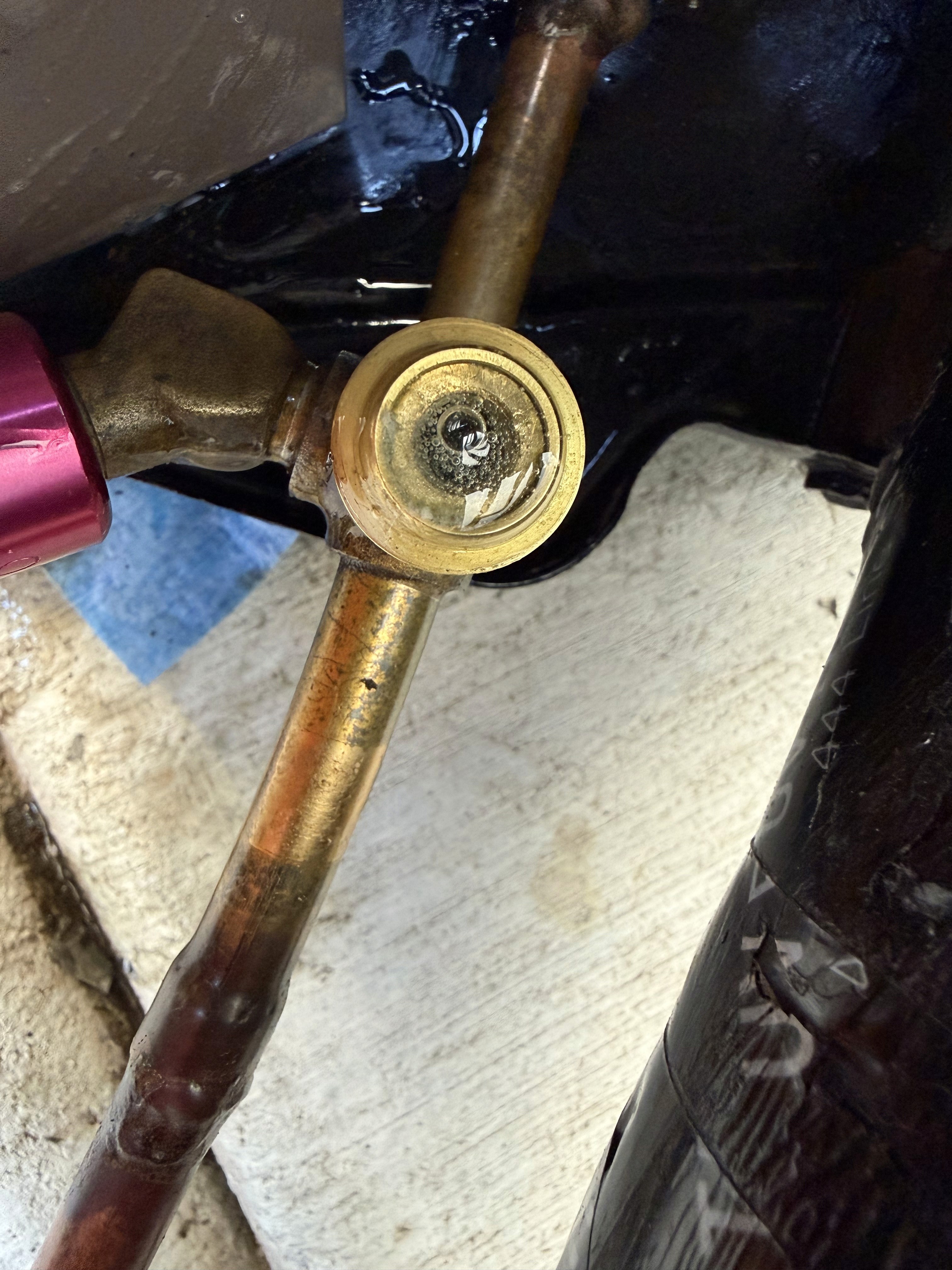
The point of loss: the brass discharge service valve, where the high-pressure line exits the compressor.
When a system is low on refrigerant, the problem compounds quietly. Less refrigerant means the compressor pulls in less of the cooling gas it needs, so it runs longer and works harder to move the same amount of heat. Working harder means drawing more electrical current and running hotter. Over time, that heat is what kills a compressor. A compressor replacement runs into the thousands and takes he system out of service for far longer than a maintenance visit ever would. That is the real cost of leaving a small refrigerant leak alone: not a slightly warmer upstairs, but the risk of the most expensive part in the system failing early.
We did not top off the charge and leave. That would have treated the symptom and ignored the source. We found the point of loss, tightened the service tee fitting, sealed it with an R-410A-compatible gasket and thread sealant, and recharged the system to manufacturer specification.
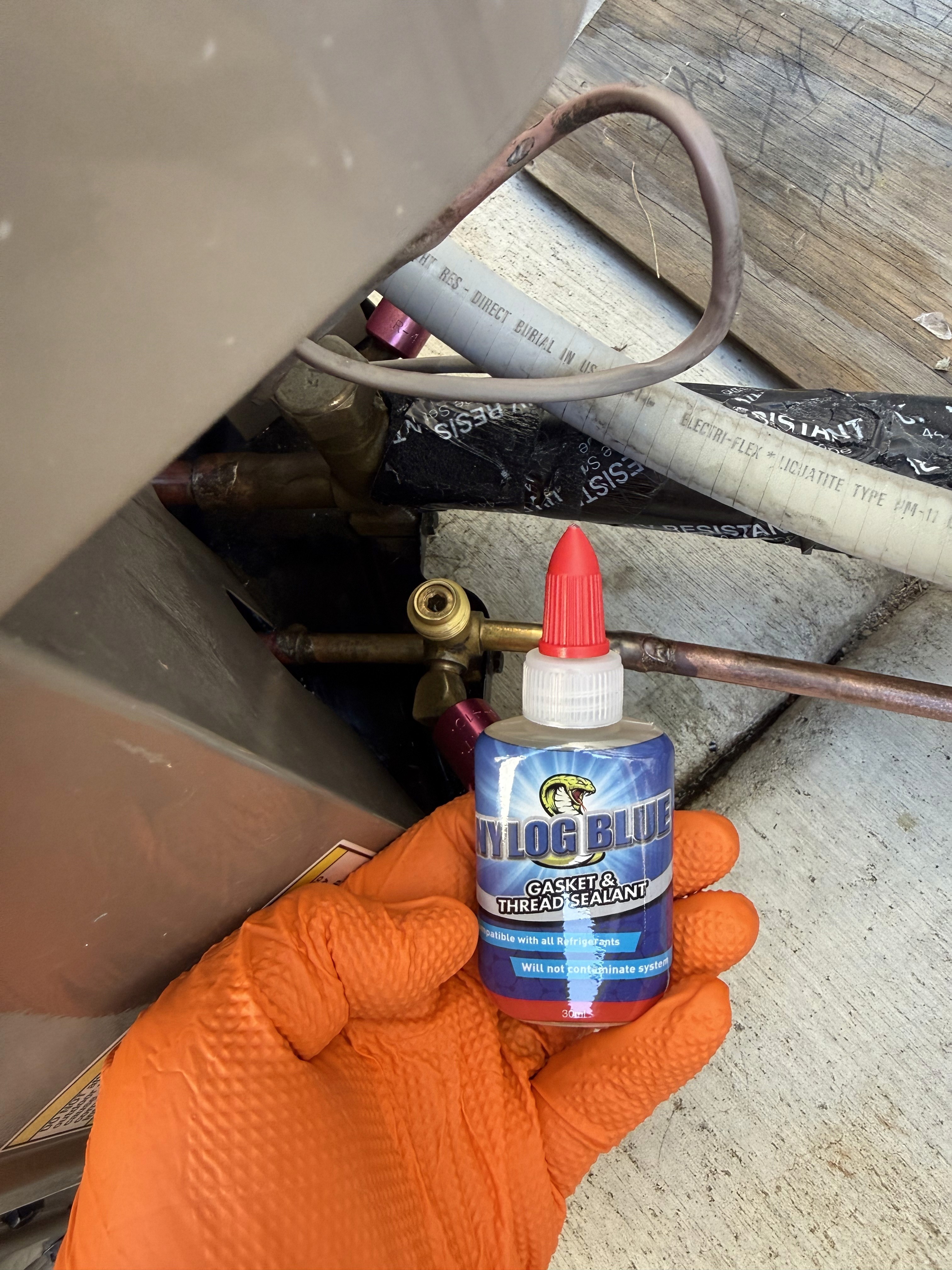
An R-410A-compatible sealant applied to the service fitting before recharging to spec.
What did the system look like after?
The air coming out of the vents dropped from 54°F to 47°F, while the air being pulled in from the rooms stayed the same at 73°F. That means the system went from cooling the air by 19 degrees to cooling it by 26. The upstairs finally cooled the way they had wanted all along, and the system ran shorter cycles to get there. The room they had quietly given up on was never the problem. The system was.
How much did it cost?
The maintenance visit that found the problem and the repair that fixed it came to a fraction of what people typically fear when they hear the words refrigerant leak. No four-figure repair. No new equipment. The system did not need replacing. It needed diagnosis and a straightforward fix.
What does a visit summary look like?
Every Northstead visit produces a documented summary: refrigerant readings, electrical measurements, temperature differentials, and findings with photos. The homeowner in this case received that report the same day. Transparency is not a feature we add to the process. It is the process.
This visit was one of the HVAC services we provide across the valley.
The room they had quietly given up on was never the problem. The system was.
The result
A 19-degree drop became 26.
We found the point of loss, sealed it, and recharged to spec - no top-off-and-leave, no new equipment. The upstairs finally cooled the way it should have all along, and the system ran shorter cycles to get there.

Built for predictable performance
If your HVAC sounds or feels different than it used to
Northstead provides residential and commercial HVAC evaluation, repair, and predictive maintenance throughout Boise, Eagle, Meridian, and the greater Treasure Valley.
Bi-annual maintenance is recommended to identify component wear before it becomes a system failure.